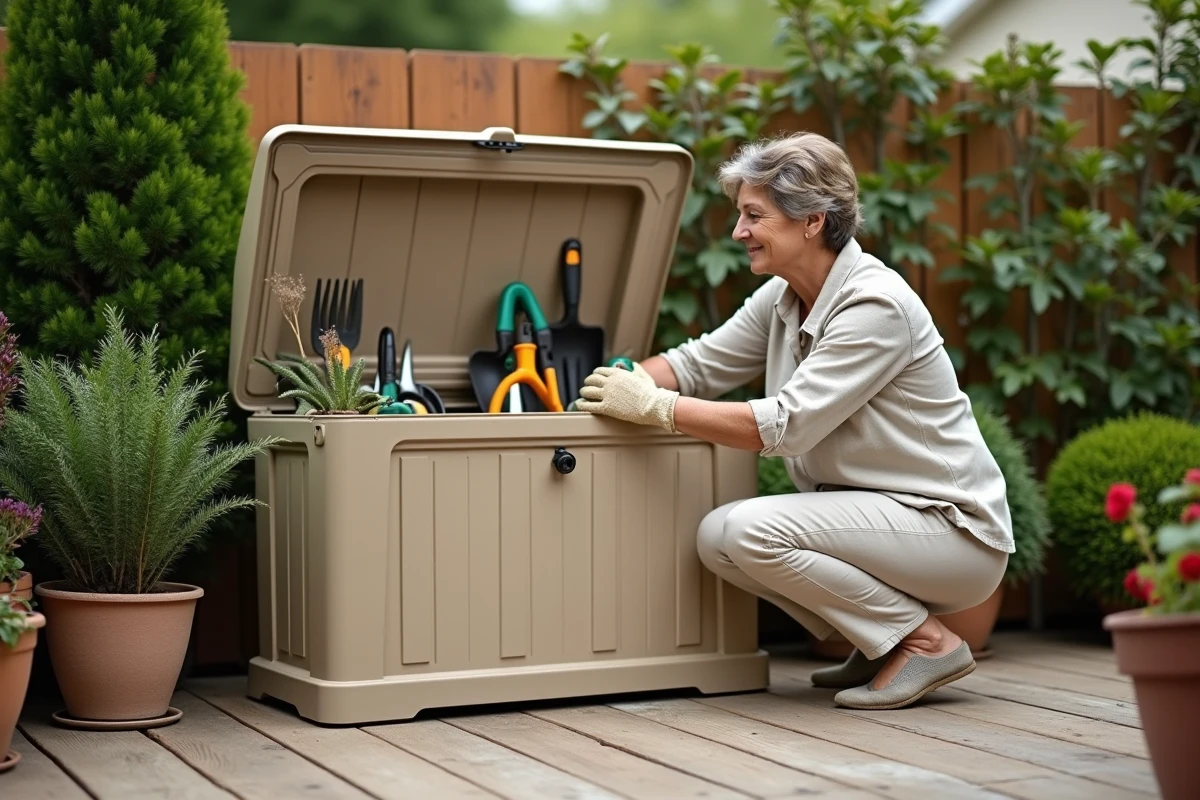
The garden storage box remains one of the most sought-after outdoor items as spring arrives, with a selection that refreshes every year in DIY superstores. At Brico Dépôt, the aggressive pricing strategy naturally attracts budget-conscious buyers. However, behind the “cheap” label, the differences between models are based on criteria rarely detailed in product sheets: color retention, compatibility with padlocks, ease of movement.
UV-resistant resin and color stability: the missing criterion in Brico Dépôt’s product sheets
The majority of garden storage boxes sold in DIY superstores are made of resin, marketed as “rot-proof” or “weather-resistant.” These claims are reassuring, but they say nothing about color retention over time.
In recent seasons, some competing models (like the Naterial Flint at Leroy Merlin) explicitly feature a UV-treated resin with a warranty against fading. This specific treatment slows down the whitening or yellowing caused by prolonged sun exposure.
Brico Dépôt’s product sheets, on the other hand, generally do not mention this type of protection. This does not mean that their boxes degrade faster, but the lack of information prevents any direct comparison. An anthracite gray box exposed full south without UV treatment can lose its original appearance in two or three summers. Checking for this mention before purchase avoids visual disappointment in the medium term.
To compare the available references and find the cheap Brico Dépôt garden box that suits your needs, storage capacity and material are not enough: UV resistance deserves to be part of the equation.
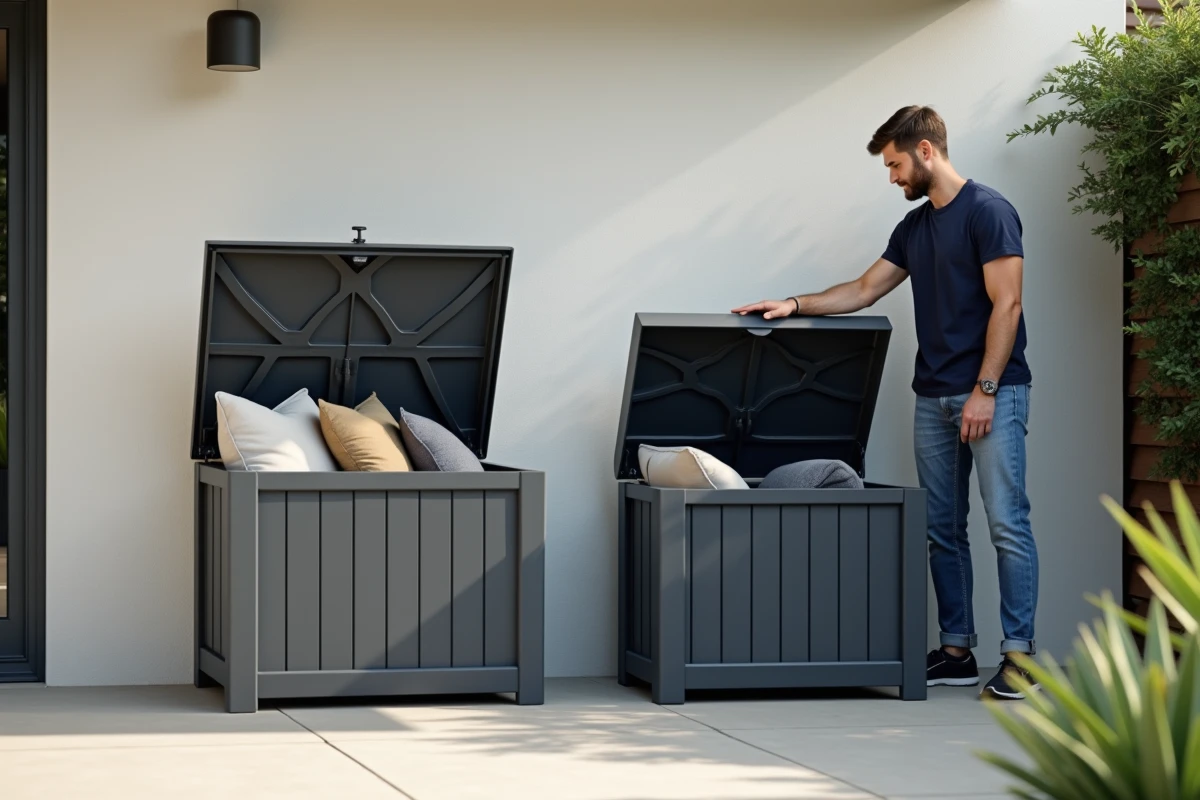
Garden box with padlock: securing outdoor storage
A garden box often stores valuable equipment: robotic lawnmowers, power tools, garden lounge cushions. However, the question of security is almost absent from usual buying guides.
Recent models offered in DIY stores increasingly incorporate a ring designed for standard padlocks, with a diameter specified directly on the product sheet. This detail changes the game for households that leave their box accessible in an open garden or in a shared property.
What to check before purchase
- The presence of an integrated locking system or a ring compatible with padlocks, with the accepted diameter clearly indicated
- The sturdiness of the anchoring point: on fine resin boxes, a clipped ring can be easily torn off, making the padlock useless
- The possibility of securing the box to the ground or against a wall, especially for lightweight models exposed to wind or theft
Metal boxes offer better structural resistance in this regard than low-end resin models. A lockable box does not replace a closed shelter, but it reduces the risk of opportunistic access, including by young children.
Tool-free assembly and wheels: ergonomics as a selection criterion
Existing content on garden boxes focuses almost exclusively on volume and material. Daily usability ergonomics are rarely addressed, even though they determine whether the box will actually be used or relegated to a corner.
Several models sold in superstores now include a tool-free clipping system with assembly claimed to take less than fifteen minutes. This type of design also facilitates disassembly at the end of the season for renters or second homes.
Wheels and integrated handles are another underestimated criterion. A large-capacity box filled with cushions or tools quickly becomes difficult to move. Models on wheels allow repositioning the box according to the seasons (shade in summer, shelter in winter) without much effort.

Resin, wood, or metal: which material for which use
The choice of material depends less on aesthetics than on the maintenance constraints accepted and the intended location.
- Resin remains the dominant material in the low-price segment: lightweight, jet-washable, it requires no annual treatment. Its limit is structural rigidity on entry-level models
- Wood (treated pine or composite) offers a more qualitative appearance but requires a stain or saturator every two to three years to avoid graying
- Metal (galvanized steel) is suitable for intensive use and heavy storage. It better withstands attempted break-ins but can rust at friction points if the coating is damaged
In the Brico Dépôt catalog, resin overwhelmingly dominates the low-price offer. Wooden and metal models exist but are in a higher price range.
Storage capacity: avoid the trap of the displayed liter
The volume advertised in liters on the label gives a rough indication, but it does not always reflect the actual usable volume. A box advertised as 280 liters may hold less than a 250-liter model if its internal walls are thick or if the shape of the bin reduces the usable space.
Internal dimensions matter more than the theoretical volume displayed. A deep and narrow box complicates the storage of flat objects like lounge cushions. A wide and shallow model facilitates access but takes up more floor space.
For small gardening tools (pruners, gloves, products), a compact box is sufficient. For lounge cushions or a lawnmower, you should aim for large capacities, often exceeding 300 liters, while checking that the internal length matches the items to be stored.
The price per liter is a more reliable indicator than the gross price for comparing two garden boxes against each other. A slightly more expensive model but offering a higher usable volume often proves to be more cost-effective than a box with a minimal price but limited actual capacity.