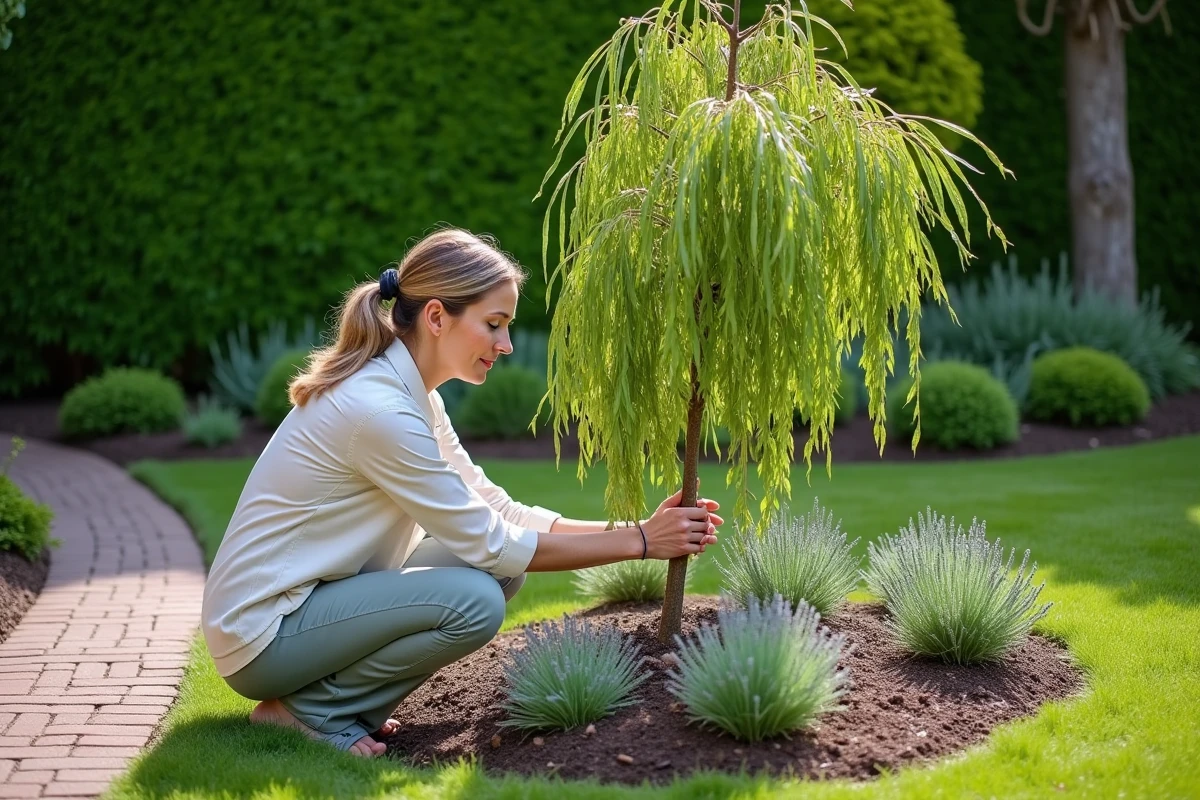
Some structural plants require companions that can temper their growth or enhance their atypical shape. The shrimp willow on a stem, despite its popularity, does not tolerate dense competition or random associations well.
Criteria of colors, textures, and water needs dictate the choice of neighboring plants. Their compatibility is never guaranteed: a poor arrangement can harm the vitality or visual harmony of the bed. Successful associations rely on precise balances, often tested by the very nature of the soil or the exposure.
The shrimp willow on a stem: a graphic and luminous asset for the bed
The brilliance of the variegated foliage of the shrimp willow on a stem, also known as Salix integra Hakuro Nishiki, captures light at all times. Native to Japan, this small tree attracts attention with its spherical shape and its shades of green, cream white, and soft pink in spring. It is impossible to confuse it: its light silhouette disrupts the monotony of classic beds and asserts a true architectural presence.
Its decorative foliage, edged in white and pink, changes with the seasons. This gives the bed a dynamic appearance that never tires. Depending on preferences, the shrimp willow can serve as a backdrop or become the centerpiece of the decor. The bed with shrimp willow on a stem then takes on a fairy-tale aspect, carried by the light that its leaves reflect even into the darker corners.
Here are three key advantages of this unique Salix:
- In autumn, the pink hues persist before the leaves fall, prolonging visual appeal.
- Growing on a stem frees up space at the base, perfect for installing perennials or ground covers while varying heights.
- The shrimp willow stem thrives in cool, sometimes moist soils, providing options where other plants struggle to settle.
This Salix structures the garden without ever suffocating it. Its growth, which is managed through pruning, facilitates the creation of sober and refined atmospheres while allowing each companion plant its place in the light.
Which plants to choose to enhance your shrimp willow? Inspirations for successful associations
Creating a bed with shrimp willow on a stem involves carefully selecting plants that will highlight its pink variegated foliage and airy appearance. Perennial geraniums form a discreet carpet, perfect for accompanying without dominating. Hostas, in partially shaded spots, provide a contrast of textures and colors that enhances the grace of Salix integra Hakuro Nishiki.
Another effective idea: install heucheras in shades of purple or caramel. Their low growth, robustness, and varied colors add a sophisticated touch without overwhelming. At the edge, Japanese anemones or dwarf asters enrich the scene and ensure flowering until the end of the beautiful season.
To compose a coherent bed, here are some association ideas:
- Carex or blue fescues mark the base of the bed and reinforce the vertical momentum of the shrimp willow.
- Epimediums cover the ground, slow the growth of unwanted grasses, and enhance the trunk.
- Behind, plant some asters or persicarias to stagger the blooms over several months.
Choosing plants to associate with the shrimp willow involves playing with contrasts of foliage, soft shades, and shapes. We seek balance, lightness, and that dynamic which evolves with the seasons so that every corner of the garden comes to life.
Harmonizing shapes and colors: practical tips for an elegant and easy-to-maintain bed
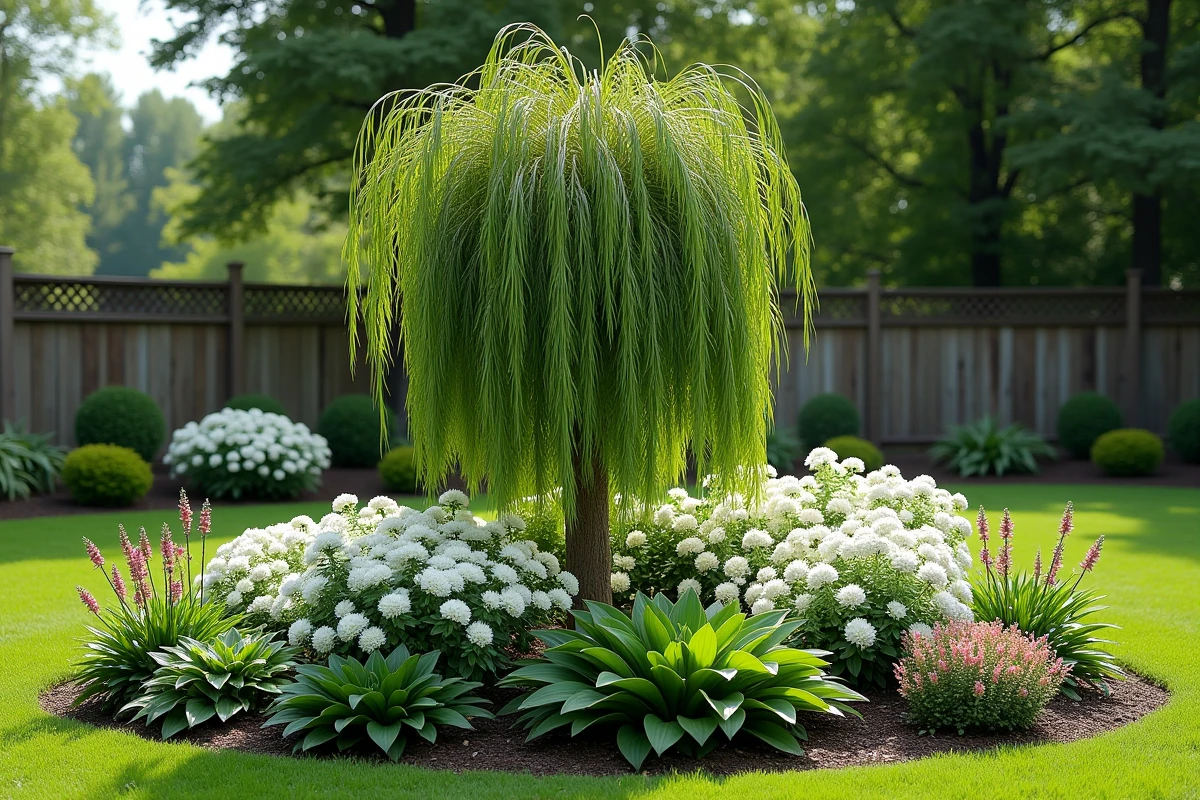
The shapes and colors determine the success of a bed with shrimp willow on a stem. To compose a harmonious ensemble, repeat certain foliage and vary the silhouettes. The pink variegated foliage of Salix integra Hakuro Nishiki deserves a surrounding that echoes its shades: at the edge, place perennials with silver or light green foliage for a marked yet soft contrast to the eye.
Low perennials like lady’s mantle, brunneras, and heucheras form a dense, stable, and easy-to-live-with base. Scatter white or pastel flowers throughout to enhance the brightness of the bed and avoid overly stark visual breaks. A few airy grasses, wisely placed, rhythm the composition and accompany the natural movement of the shrimp willow on a stem without stealing the spotlight.
Practical maintenance tips
To keep a harmonious and durable bed, here are some recommendations to follow:
- Favor autumn planting to promote rooting.
- Care for the soil: it should remain cool but permeable to avoid any root asphyxiation in spring.
- Prune the shrimp willow each year to maintain its shape and stimulate the regrowth of its young decorative leaves.
- Moderate fertilizer applications: a well-thought-out bed functions autonomously over time.
Working on a bed with shrimp willow on a stem means observing, adjusting, and listening to what the earth says. The interplay of colors and heights, controlled yet never fixed, ensures a lasting graphic presence, without excess or unnecessary chores.
The shrimp willow on a stem is the promise of a living garden that awakens differently with each season. One strolls through it, surprised by the light, charmed by the simplicity. And what if, this year, it became the star of your compositions?